

For decades, the standard blueprint for developing nations seeking rapid economic growth was simple: dig raw minerals out of the ground, chop down timber, pump out crude oil, and load raw materials onto cargo ships bound for industrial powerhouses in Europe, North America, and East Asia.
For Indonesia, Southeast Asia’s largest economy, boasting a population of over 278 million people, this reliance on commodity exports provided comfortable growth. Yet it also left the archipelago trapped in a classic economic paradigm: exporting cheap dirt and importing expensive refined goods.
Now, Jakarta is executing one of the most aggressive economic gambits in modern history. The policy is officially termed hilirisasi - an Indonesian word translating literally to "downstreaming," or moving processing and refining operations further down the industrial supply chain. By banning the export of unprocessed critical minerals like nickel ore, Indonesia is forcing global corporations to build multi-billion-dollar smelters, refineries, and battery factories directly on Indonesian soil.
The goal is ambitious. Indonesia wants to escape the Middle-Income Trap, a macroeconomic situation where a developing country reaches a comfortable middle level of income but stalls before becoming a wealthy, high-income nation. With President Prabowo Subianto targeting an aggressive 8 percent annual Gross Domestic Product (GDP) growth rate to achieve the nation’s "Golden Vision 2045" (the centenary of Indonesian independence), the clock is ticking (Prabowo).
Can hilirisasi create high-paying industrial jobs, spark domestic innovation, and power Indonesia into the top tier of world economies? Or will resource nationalism, geopolitical pushback, environmental degradation, and the shifting landscape of clean technology stall the giant before it reaches the finish line?
What Is “Hilirisasi” and Why Does It Matter?
To understand hilirisasi, one must first grasp the core problem of raw resource exports. Imagine an island rich in cocoa beans. If that island exports raw beans at $2 a kilogram to a foreign chocolatier, and then buys back packaged chocolate bars at $30 a kilogram, the vast majority of economic profit, as well as the skilled engineering, marketing, and logistics jobs, remains abroad.
Indonesia found itself in this exact position with mineral resources, particularly nickel. Nickel is a silvery-white metal historically valued for making stainless steel. However, in the clean energy transition, nickel has emerged as an essential ingredient in lithium-ion batteries that power electric vehicles (EVs).
In 2020, under former President Joko Widodo ("Jokowi"), Indonesia reinstituted a strict, sweeping ban on raw nickel ore exports (Prakoso et al.). The message to foreign buyers was blunt: If you want our nickel, you cannot just buy our ore. You must bring your capital, technology, and engineers here to process it.
The initial figures suggest the policy yielded undeniable results. In 2013, before early export restrictions began, Indonesia’s total export value from raw nickel ore stood at roughly $6 billion (Abdurrachman). By 2023, following the full export ban and subsequent boom in domestic processing, exports of value-added nickel products, such as ferronickel, nickel pig iron, and stainless steel, soared to $33.8 billion (Indonesia.go.id). By 2024, Indonesia supplied nearly 58 percent of global nickel output (CSIS).
Why is Indonesia betting its economic destiny on mineral processing? Because the alternative is economic stagnation.
The Middle-Income Trap is a term coined by World Bank economists Indermit Gill and Homi Kharas in 2007. It describes a structural hurdle faced by developing nations. When a country is poor, it can achieve rapid economic growth simply by shifting low-skilled agricultural workers into basic, low-cost labor activities like garment manufacturing or resource extraction.
However, as living standards rise, national wages increase. The country becomes too expensive to compete with poorer nations for low-wage assembly, yet lacks the advanced technology, high-skilled workforce, and domestic innovation required to compete with rich nations like Japan, South Korea, or Germany.
Historically, very few countries have successfully bridged this chasm. Out of 101 middle-income economies in 1960, only 13 managed to become high-income economies by 2008 (World Bank). Nations like South Korea successfully broke the trap by transitioning from basic labor-intensive assembly to advanced, home-grown technological innovation and deep industrial integration. Conversely, countries such as Brazil and Argentina remained stuck in middle-income status for decades despite vast mineral and agricultural wealth, having failed to build domestic technological capability or shift beyond raw commodity export dependencies.
Indonesia's current Gross National Income (GNI) per capita floats around $4,900. To join the high-income club, defined by the World Bank as having a GNI per capita above roughly $14,005, Indonesia must sustain an average annual GDP growth rate of at least 6 to 7 percent over the next two decades. Yet for the past decade, Indonesia's real GDP growth has hovered consistently around 5 percent.
Adding to the urgency is premature deindustrialization, a phenomenon where a developing nation's manufacturing sector begins to shrink as a percentage of the total economy long before the country becomes wealthy (Dani Rodrik). Indonesia’s manufacturing contribution to national GDP peaked in 2001 at roughly 29 percent, but has steadily drifted down to approximately 18 percent (World Bank; Trading Economics).
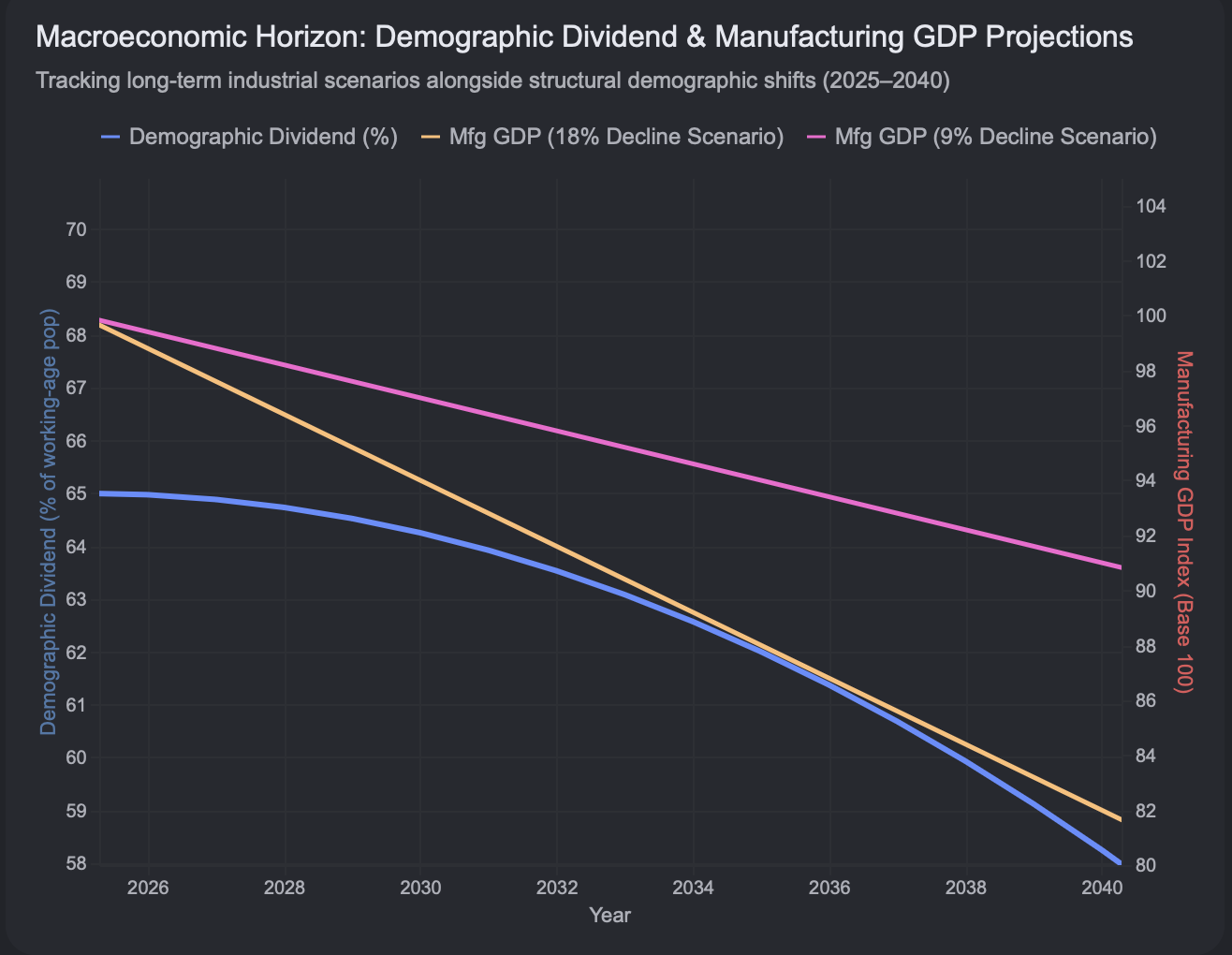
Tracking long-term industrial scenarios alongside structural demographic shifts (2025–2040). Chart: Kawang Luk.
Without a massive economic jolt to revitalize advanced manufacturing, Indonesia risks growing old before it grows rich. Hilirisasi is designed to be that necessary jolt.
The Strategy
By demanding that raw materials be processed locally, hilirisasi aims to trigger three beneficial macroeconomic effects:
- Capturing Value-Add: The core economic transformation lies in value addition, as in the difference between the sale price of a finished product and the cost of the raw inputs used to make it. Unprocessed nickel ore sells for tens of dollars per metric ton; battery-grade refined nickel chemicals sell for tens of thousands of dollars per ton.
- Attracting Foreign Direct Investment (FDI): Foreign Direct Investment refers to cross-border capital investments made by foreign corporations to establish factories or long-term business operations. Because global manufacturers could no longer purchase raw Indonesian ore, giants like China’s Tsingshan Holding Group and CATL poured tens of billions of dollars into industrial parks in Central Sulawesi and the Maluku Islands to build industrial smelters.
- Upgrading Infrastructure and Local Skills: The influx of capital requires deepwater ports, power grids, technical vocational institutes, and transportation networks, modernizing neglected outer island provinces outside the densely populated main island of Java.
Yet, moving from raw nickel ore to high-value electric vehicle batteries is not a simple linear task. It requires going through four complex stages.
First, extraction of raw nickel ore, which is highly abundant and has low value. Second, smelting the ore into nickel pig iron, which is used for stainless steel and has medium value.
Third, refining, which turns the pig iron into class 1 high-purity nickel.
And lastly, the end products, which are the EV battery cells and electric vehicles.
Currently, the vast majority of Indonesia’s hilirisasi boom remains clustered at Level 2 (converting raw ore into nickel pig iron and ferronickel for stainless steel). While this generated impressive top-line export numbers, it occupies the lower tier of downstream processing. The true prize, mass-producing domestic battery cells and localized electric vehicle manufacturing (Level 4), remains in its early stages.
Cracks in the Smelter
While the growth of industrial parks in Morowali and Weda Bay looks impressive from above, a closer inspection reveals significant vulnerabilities that could limit hilirisasi's long-term effectiveness.
A. Geopolitical Backlash
When a country blocks raw material exports, it disrupts global supply chains. The European Union filed a formal complaint against Indonesia at the World Trade Organization (WTO) in 2019, arguing that the nickel export ban illegally restricted free trade (Caillet).
Furthermore, because Western corporations were initially hesitant to invest in high-risk, energy-intensive smelting projects in regional Indonesia, Chinese firms stepped in to fill the gap. Today, Chinese capital dominates Indonesia’s nickel processing infrastructure, funding over 70 percent of active smelter capacity (NUS LKY School).
This concentration creates a strategic complication: under the U.S. Inflation Reduction Act (IRA), electric vehicles containing battery components produced by companies with significant foreign ownership from "Foreign Entities of Concern" (including China) are ineligible for lucrative U.S. consumer tax credits. Consequently, Indonesian processed nickel risks being locked out of the lucrative North American EV market, leaving the nation heavily reliant on a single dominant trade partner.
B. ESG Friction
Processing nickel ore into battery-grade material is an energy-intensive process. Because Indonesia's national power grid remains dependent on fossil fuels, most remote smelter industrial parks rely on captive coal-fired power plants built exclusively to run processing furnaces.
This creates a paradox: the materials needed to power the global green energy transition are being refined using heavy carbon emissions. High carbon footprints, coupled with concerns regarding deforestation, ocean waste disposal (tailings), and industrial workplace safety, have caused several Western EV automakers to hesitate before integrating Indonesian nickel into their tier-one supply chains.
For the social aspect, the labor bottleneck is highlighted by national education and employment metrics: as of 2023, tertiary education attainment in Indonesia remains under 13% of the working-age population, while STEM graduates account for less than 15% of annual higher-education output (World Bank). Consequently, foreign industrial parks in Morowali have relied heavily on thousands of expatriate Chinese technicians to manage high-pressure acid leach (HPAL) systems, underscoring the gap between local labor capability and complex metallurgical processing.
C. Resource Depletion
Industrial capacity can outpace physical resources. Indonesia’s rush to construct smelters created overcapacity in low-grade nickel processing. The Ministry of Energy and Mineral Resources estimated that at current consumption rates, Indonesia’s high-grade nickel reserves could face depletion within a decade unless major new deposits are discovered or processing efficiency improves dramatically (Permen ESDM; Siahaan et al.). Indonesia has even had to import low-grade nickel ore from neighboring countries like the Philippines to feed its massive array of domestic processing plants.
D. Threat of Substitution
Economic strategies that rely heavily on a single mineral face the risk of technical obsolescence. As nickel prices rose and ethical concerns persisted, battery scientists accelerated the development of alternative technologies.
Enter the LFP battery (Lithium Iron Phosphate). LFP batteries use no nickel or cobalt whatsoever. They are cheaper to produce, safer from thermal runaway (fire risks), and possess longer cycle lives, despite having lower energy density than nickel-heavy alternatives (NMC: Nickel Manganese Cobalt). Automakers like Tesla, BYD, and Ford have shifted significant portions of their standard-range vehicle fleets to LFP chemistry. If global battery innovation shifts away from nickel, Indonesia risks holding billions of dollars in specialized smelting infrastructure designed for a market that moved on.
What Indonesia Must Do to Break the Trap
For hilirisasi to act as an engine that pulls Indonesia past the middle-income barrier, downstreaming cannot end at primary smelting. The government must transition from basic resource processing to comprehensive industrial policy.
From Smelting to Complete Manufacturing
Converting raw ore into semi-processed ferronickel is only an intermediate step. To capture true economic value, Indonesia must manufacture battery cells, cathode materials, and assembled vehicles domestically. This requires establishing integrated industrial ecosystems where processing plants, battery makers, and automotive assembly operations operate side by side.
Decarbonize the Smelting Process
To satisfy global ESG requirements and access Western markets, Jakarta must aggressively replace captive coal plants with renewable energy. Indonesia possesses vast geothermal energy potential, as well as significant hydro and solar capacity. Transitioning industrial hubs to renewable power is essential to ensure that "green minerals" are processed sustainably.
Build Human Capital and Innovative Technology
A nation cannot enter high-income status purely on foreign technology. True economic development requires technology transfer, agreements requiring foreign firms to train local workers, share technical expertise, and conduct research within the host country. Indonesia must invest heavily in higher education, engineering programs, and scientific research. Without a skilled domestic workforce capable of designing, maintaining, and innovating advanced industrial machinery, Indonesia will remain dependent on foreign engineers.
Avoid Dutch Disease through Economic Diversification
Dutch Disease is an economic term coined by The Economist in 1977. It describes a scenario where a sudden surge in exports of one natural resource (like nickel or oil) causes the national currency to appreciate. This currency strengthening makes a nation's other export sectors, such as agriculture, textiles, services, or electronics, more expensive and less competitive on the global market.
To avoid falling into this trap, Indonesia must ensure hilirisasi is not limited to mining. The same downstreaming principles must be applied to sustainable agriculture (processing raw palm oil into specialty food chemicals and biofuels), marine resources, forestry, and an expanding digital service economy.
Conclusion: The Golden Window
Indonesia stands at a critical juncture in its history. The nation is currently benefiting from a demographic dividend, a time window where the working-age population is larger than the dependent population (the young and the elderly). This demographic sweet spot will peak over the next fifteen to twenty years before the population begins to age.
Hilirisasi represents an assertive challenge to the traditional international division of labor. It rejects the idea that developing nations must remain permanent suppliers of cheap raw materials to industrialized countries.
However, banning exports and building smelters is merely the foundation of the economic house, not the house itself. If Indonesia relies entirely on raw mineral processing without investing in local innovation, renewable energy, human capital, and broad manufacturing diversification, it risks replacing raw resource dependency with processed mineral dependency, remaining stuck in the middle-income trap while its mineral reserves deplete.
Time is the ultimate constraint. If Jakarta can navigate geopolitical tensions, green its industrial grid, and upgrade the skills of its workforce before its demographic window closes, the "Delayed Giant" of Southeast Asia may finally claim its seat among the world's leading economies. If it fails, hilirisasi will be remembered as a missed opportunity: a brilliant short-term export boom that fell short of meaningful long-term transformation.

